Off the record, formally
Summary. Groups already follow rules about what a meeting may remember. Robert's Rules of Order, the Chatham House Rule and reporters' attribution terms all limit what gets kept and who gets named. Goldfish, a recorder we designed, applies these limits in code. We have now written its memory rules as one formal model, tested against the device software.1 This brief covers the model in five points, then compares it with meeting rules.
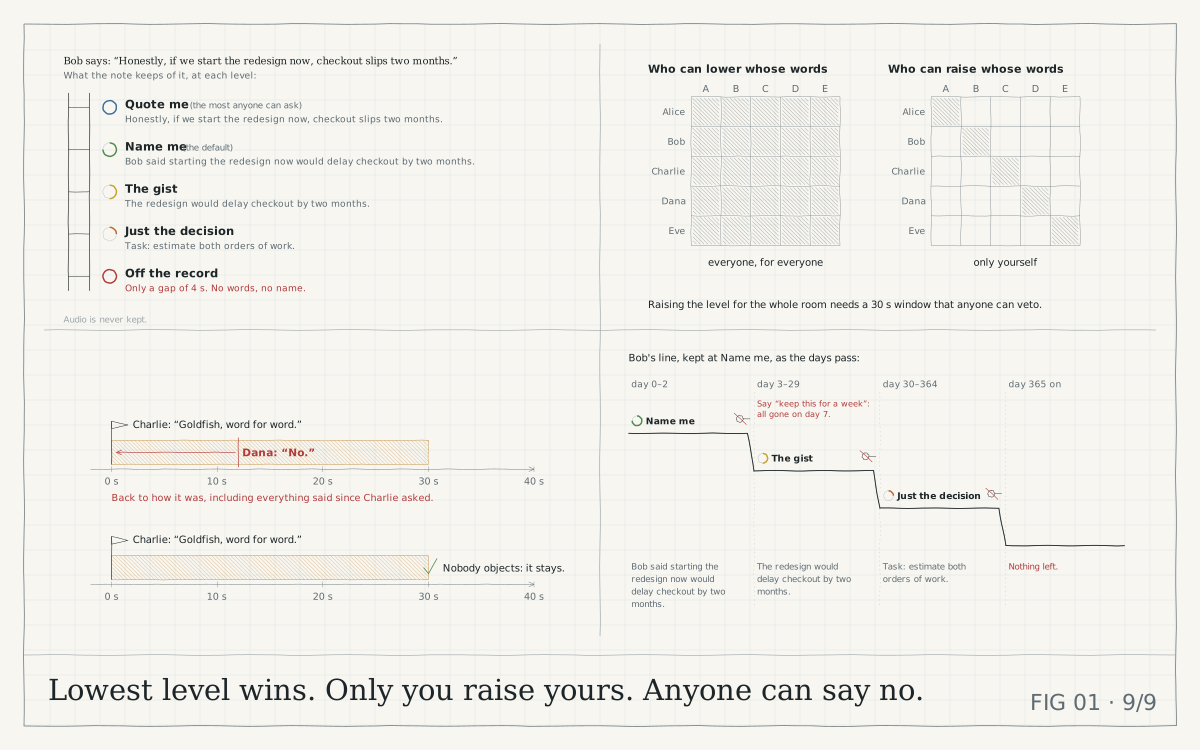
Step through the figure, one step at a time.
1. Each person sets a level for their own words
Goldfish keeps speech at one of six levels. Each level includes everything below it.
| Level | Name | What Goldfish keeps |
|---|---|---|
| 0 | Off the record | Only that a gap happened, and its length |
| 1 | Just the decision | Decisions, and who owns each task |
| 2 | The gist | A summary, with no names |
| 3 | Name me | Who said what, in paraphrase |
| 4 | Quote me | The exact words |
| 5 | Audio | The recording6 |
Goldfish applies the lowest of three limits to each person's words:
level = min( request, room limit, group limit )
The request is what the person asked for, or the default of 3. The room limit covers everyone, for example after "off the record". The group limit covers one side conversation.
2. Anyone can lower the level; only you can raise your own
Anyone can lower the level for the whole room, at any time, without a reason. Only you can raise the level of your own words. Two tables show who may change whose level:
Lower = all ones    anyone, for everyone
Raise = diagonal    you, for yourself only
One exception: a person can raise the level for the whole room by saying the device's name, for example "Goldfish, word for word". The raise starts at once but stays provisional for 30 seconds. If anyone says "no" in that time, Goldfish cancels the raise and lowers everything said since. Robert's Rules works the same way: "a single objection defeats a request for general consent".2 Goldfish keeps the veto and drops the vote that follows.
3. Goldfish forgets in three fixed steps
Goldfish removes detail on a fixed schedule:
days 0–2      up to level 5
days 3–29     up to level 2
days 30–364   up to level 1
day 365 on    nothing
A line kept at "Name me" therefore loses its names after 3 days, its reasoning after 30 days and its decisions after a year. A spoken limit shortens every step: "keep this for a week" removes everything on day 7. Fixed steps, unlike a gradual curve, let the note show a delete date for each section. Goldfish enforces the schedule by destroying encryption keys.3
Robert's Rules does the opposite: its 1915 edition requires struck words to stay readable, so members can check "whether more was expunged than ordered". Goldfish keeps a record of the gap and deletes the words.
4. Speaker labels last one session
Goldfish labels up to ten speakers v1, v2 and so on, in order of first speech. It never stores names. Ten minutes of silence ends the session and deletes the labels, so no label links two sessions. Robert's Rules asks members to say "the member who spoke last" rather than a name; Goldfish applies that idea to the record.
When Goldfish cannot tell who spoke, it keeps less:4 a request to lower your own words lowers the whole room, and a request to raise them has no effect.
5. Example: a five-person session
We ran a five-person sample session through the device software.5
- Someone presses the eye, and the room goes off the record.
- Dana asks Goldfish to keep her words "to the gist".
- A double press brings the room back on the record, provisionally.
- Goldfish keeps nothing of Bob's "between us" remark.
- Charlie says "back on the record", but a press within 30 seconds cancels it, and his proposal is lost.
- Alice asks for "just the decisions", and Dana asks to be left out.
The session note keeps 6 decisions and tasks for one year, 11 summary lines for 30 days and 10 named lines for 3 days. Dana appears in none of the named lines.
How Goldfish compares with meeting rules
Meeting rules control two things: how much content survives, and whether the speaker is named. Goldfish combines both into one scale, so each rule maps to the highest level that respects it.
| Rule | Goldfish match | Main difference |
|---|---|---|
| Chatham House Rule | 2, The gist | No exact words without a name |
| Minutes under Robert's Rules | 1, Just the decision | No name for who made a motion |
| Reporters' "background" | 2, The gist | No job title for the source |
| Sociocratic consent | The 30-second objection | An objection needs no reason |
| Quaker minutes | No match | The group does not approve the note first |
The IETF takes the opposite approach: by taking part, people agree to be recorded. Goldfish never treats its default level as consent.
Open questions
- Should Goldfish add a level for exact words without names?
- Should the group approve the note before Goldfish writes it, as a Quaker meeting approves its minute?
- If the clock fails, should Goldfish keep the decisions, as it does now, or nothing, as the spec says?
Sources
Robert's Rules of Order, 1876 and 1915; Chatham House Rule; AP; IETF Note Well; Sociocracy For All; Quaker faith & practice.
-
Goldfish is designed and simulated, not yet built. The formal model is MEMORY-MODEL.md. ↩
-
Robert's Rules of Order Revised (1915), §48. We quote the public-domain 1876 and 1915 editions, not the current edition. ↩
-
Key destruction is tested in software, not yet on hardware. Goldfish deletes at midnight UTC, so it can delete up to a day early, never late. ↩
-
"Cannot tell" means the speaker-recognition confidence is below 0.8. ↩
-
A person wrote the paraphrases in the example note. The levels and dates come from the device software. ↩
-
Goldfish never keeps audio. ↩